
This project built a privacy-aware data federation infrastructure at Umeå University: a system that lets researchers analyse data from many different databases together, without first copying it all into one place, and with privacy protection built in. It was part of the university’s investment in federated databases for research, and served both as a practical service and as a research testbed. I worked on it as a postdoctoral researcher in the Deep Data Mining group from 2018 to 2020.
The problem
Research questions about health, ageing, demographic change or social behaviour often need data held by different organisations, collected for different purposes and stored in different ways. Two obstacles stand in the way:
- Heterogeneity. Sources use different data models (relational tables, plain text, statistical files such as SAS or SPSS), different names for the same thing (“date of birth” in one, “age” in another) and different units and conventions, with duplicates and contradicting records.
- Privacy. Combining sources makes it easier to single people out, and obtaining consent to use identifiable data can be prohibitively costly. Without provable privacy protection, sharing does not scale.
The approach
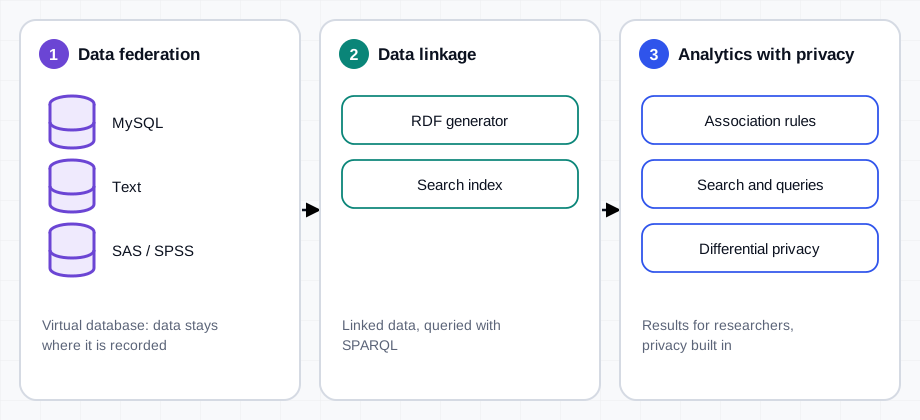
The infrastructure has three stages:
- Data federation. A virtual database connects the sources in real time, so that data is accessed and combined across systems without being copied or moved from where it is recorded.
- Data linkage. Our own RDF generator converts the federated data into linked data, so that records from different sources can be connected and queried with semantic web tools (SPARQL), and a search index makes text data searchable.
- Data analytics with privacy. Users explore patterns across sources with association rules, then search and query the data for their own research questions. Differential privacy protects the results, including methods that set the privacy budget per individual and differentially private text embeddings.
Results
- A working, graph-based data federation system, presented as a demo at TheWebConf 2019 (formerly WWW), with a video of the system.
- WINFRA, an open-access web platform for semantic data retrieval and analytics over federated data, combining natural language processing with data mining.
- kbot, a chatbot that answers natural-language questions over linked data, published in IEEE Access.
- Methods for improving RDF data through semantic association rule mining, and a study of privacy concerns around AI and social network data, both presented at SAIS 2019.
The central question of this project, how to learn from data that should not be pooled, carries through to my later work on federated learning.