

ProcTwin, short for Integrated modelling for sustainable and optimized steel manufacturing processes, is a four-year EU Horizon Europe project within the Clean Steel Partnership. It builds a demonstration platform that predicts and visualises the best way to run a whole chain of processing steps in a steel plant, with energy efficiency and product quality as the two goals.
The problem
Steel is made in a sequence of steps, such as continuous casting, reheating, hot working, quenching and levelling. Each step has its own control system and is usually optimised on its own. But the steps are strongly connected: how a slab is cast affects how it must be reheated, and how it is rolled affects how it can be quenched. Optimising one step at a time leaves energy and quality on the table.
Doing better needs a model of the whole chain, built from data that sits in different systems, at different sites and in different companies, and that cannot simply be pooled.
The approach
ProcTwin couples the process steps through a combination of three kinds of models:
- physics-based models of each process step, adapted so that they can be connected to each other;
- soft sensors and new measurement techniques, which estimate quantities that are hard to measure directly on the production line;
- distributed machine learning across the process chain, with secure data sharing, so that models can learn from data held by different steps and different partners.
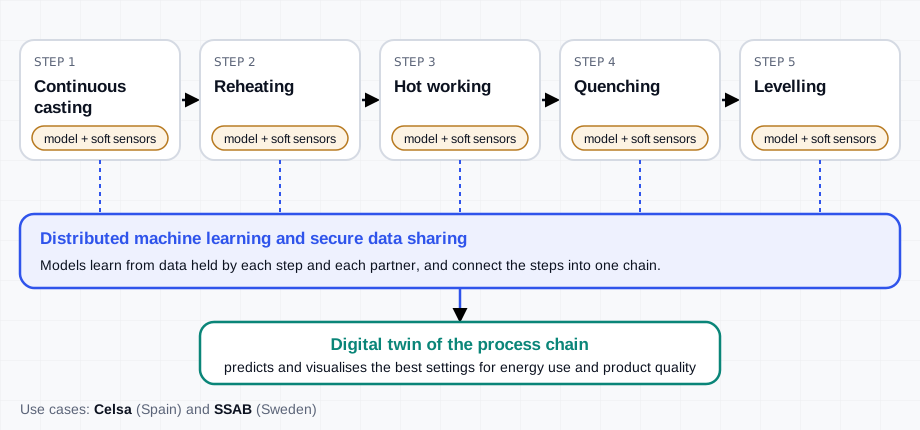
The platform is demonstrated in two parallel industrial use cases, at Celsa in Spain and SSAB in Sweden.
Our part
At the University of Skövde, our work focuses on the distributed machine learning that connects the process steps: learning from data that stays with each step and each partner, in the spirit of federated learning. PhD student Abed Al Bakkour works on distributed AI in the steel industry within the project.
The consortium
The project is coordinated by Swerim (Sweden) and brings together research institutes, steel producers and technology companies:
| Partner | Country | Type |
|---|---|---|
| Swerim (coordinator) | Sweden | Research institute |
| University of Skövde | Sweden | University |
| SSAB | Sweden | Steel producer |
| Prevas | Sweden | Technology company |
| VDEh-Betriebsforschungsinstitut (BFI) | Germany | Research institute |
| Materials Center Leoben | Austria | Research centre |
| CARTIF | Spain | Research centre |
| Celsa | Spain | Steel producer |
| Global Steel Wire | Spain | Steel producer |
| Aquiles Solutions | Spain | Technology company |
| Ingeniería y Sistemas de Ensayos No Destructivos | Spain | Inspection technology |
| ESTEP, the European Steel Technology Platform | Belgium | Industry platform |
Results so far
The project started in January 2025 and runs until the end of 2028. Publications, software and demonstrators will be listed here as they appear; follow News for updates.